A quiet but powerful shift has been reshaping the housing market across much of the East Coast. Homeowners are staying in their homes longer than they used to, and that single change helps explain many of the dynamics buyers and sellers are experiencing today.
Nationally, the typical homeowner now stays in their home for about twelve years. Two decades ago the typical tenure was closer to six and a half years. That change has far reaching consequences. When homeowners stay longer, fewer homes come up for sale. When fewer homes are listed, inventory tightens, competition intensifies, and price stability becomes more resilient even when mortgage rates fluctuate.
For buyers and sellers across the Mid Atlantic and Southeast, understanding this trend is essential. It affects everything from the timing of a move to the strategy required to compete in today’s market. It also helps explain why the housing market sometimes feels slower even when demand remains strong.
This article explores what is driving longer homeowner tenure, how the trend shows up in markets across the eastern United States, and what buyers and sellers can do to navigate a market where turnover has slowed but opportunity still exists.
The Long Shift in How Americans Move
The way Americans move has changed dramatically over the past twenty years.
In the early 2000s, homeownership often followed a faster cycle. Many homeowners treated their first home as a stepping stone. Families upgraded sooner as incomes grew, relocations for work were common, and housing appreciation encouraged people to trade up or move frequently.
By 2005 the typical homeowner stayed in their home for about six and a half years before selling.
Over time, that pattern began to shift. By 2020 the median tenure had climbed to more than thirteen years. That meant homeowners were staying roughly twice as long as they had just fifteen years earlier.
The pandemic temporarily interrupted the trend. Mortgage rates dropped below three percent and remote work created new flexibility around where people could live. Millions of households used the moment to relocate, upgrade homes, or move closer to family. That surge in mobility briefly pushed tenure down again.
As interest rates rose and housing affordability tightened in the years that followed, the trend reversed once more. Home sales slowed to levels not seen in decades and homeowner tenure began rising again. Today the national median sits around twelve years, the longest stretch since the early pandemic period.
When homeowners stay longer, the ripple effects spread throughout the housing market. Fewer homes come to market each year. Buyers compete for a smaller pool of properties. Sellers who do list often face strong demand, but they must also consider the cost of replacing their current home in a higher rate environment.
Understanding what is driving this trend helps explain why the housing market behaves the way it does today.
Why Homeowners Are Staying Put
Several powerful forces are encouraging homeowners to remain in place longer than they once did. Some are financial. Others are demographic. Together they have created what economists often describe as a structural shift in housing mobility.
The most widely discussed factor is the mortgage rate lock in effect.
Between 2020 and 2022 millions of homeowners refinanced or purchased homes at historically low mortgage rates. Many households secured fixed rates between two and three and a half percent. Those rates dramatically lowered monthly payments and locked in long term affordability.
Today mortgage rates have spent much of the past several years in the six to seven percent range. For a homeowner with a four hundred thousand dollar mortgage at three percent, replacing that loan with a new loan around six and a half percent could increase the monthly payment by hundreds of dollars. In many cases the increase can approach or exceed a thousand dollars depending on loan size and market prices.
That financial reality creates a strong incentive to stay put. Even homeowners who would otherwise consider moving often hesitate when faced with the prospect of trading a historically low mortgage payment for a significantly higher one.
Another major factor is equity growth. Home values across much of the country rose substantially during the past decade. Many homeowners who purchased before 2018 have accumulated significant equity. While that equity represents financial strength, it also creates a dilemma. Selling means realizing gains, but it also means entering a market where replacement homes are often more expensive.
Demographics also play an important role. Large numbers of homeowners from older generations are choosing to age in place. Instead of downsizing immediately after children leave home, many households remain in properties they have owned for decades. Studies show that empty nest households control a large share of homes with three or more bedrooms, often holding those properties longer than previous generations.
Finally, there is the human factor. The longer people stay in a home, the more rooted they become. Neighborhood relationships deepen. Children grow up in local school systems. Communities become part of daily life. Those connections make moving less appealing unless there is a compelling reason to relocate.
Together these forces create a market where homeowners simply move less often than they once did.
What the Data Shows Across Key East Coast Markets
Although the national trend is clear, the way homeowner tenure shows up across different markets can vary significantly. Factors such as affordability, job mobility, local demographics, and housing supply all influence how long homeowners typically remain in place.
The following table summarizes homeowner tenure patterns and housing price context for several major markets across the Mid Atlantic and Southeast.
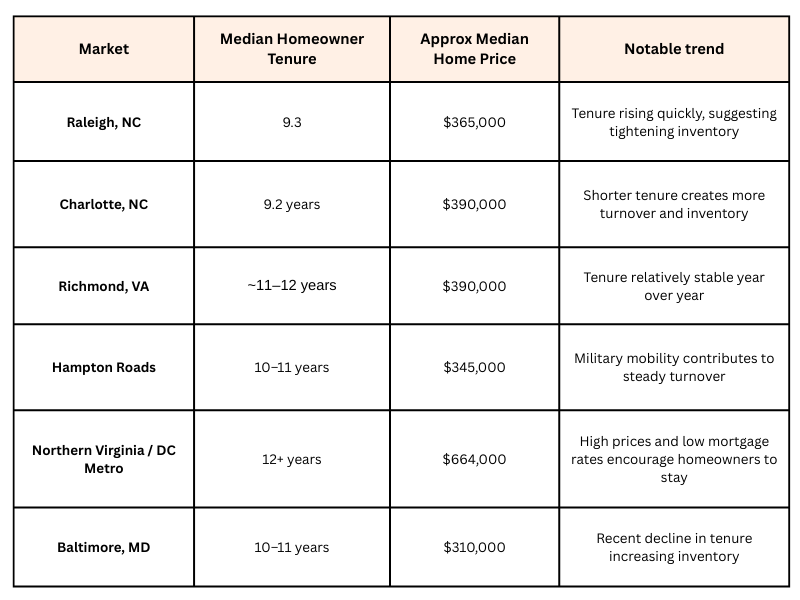
While these figures vary by county and neighborhood, the broader patterns illustrate how housing markets behave differently depending on local conditions.
More affordable markets often see shorter homeowner tenure because mobility is easier and replacement housing remains accessible. Higher priced markets tend to experience longer tenure because homeowners have more to lose financially when selling.
Understanding these patterns can help buyers and sellers evaluate where opportunities may emerge.
What Longer Tenure Means for Buyers
For buyers across the Mid Atlantic and Southeast, longer homeowner tenure translates into one simple reality. There are fewer homes available for sale at any given moment.
When turnover slows, listings appear less frequently. Buyers often find themselves watching the market closely, waiting for the right property to appear. When it does, competition can intensify because multiple buyers have been waiting for similar opportunities.
That does not mean the market is impossible to navigate. It simply means preparation matters more than ever.
Buyers who succeed in low inventory environments tend to start with strong financial preparation. Getting pre approved before actively shopping provides clarity about budget and strengthens offers when the right home appears.
Understanding available loan options can also open doors. Programs such as FHA loans, VA loans for military families, and certain down payment assistance programs can make homeownership more accessible even when inventory is tight.
Another important factor is speed and coordination. When buyers work with a team that communicates effectively between the real estate and mortgage sides of a transaction, they are often able to move more quickly and confidently.
At CapCenter, real estate agents and loan officers work together from the beginning of the home search process. That coordination can reduce delays and help buyers compete more effectively when desirable homes come to market.
What Longer Tenure Means for Sellers
For homeowners considering a sale, longer tenure trends can create meaningful opportunity.
When fewer homeowners list their properties, the homes that do reach the market often attract significant interest. Buyers who have been searching for months may act quickly when they find the right property.
Many homeowners across the East Coast are also sitting on substantial equity. Home values have appreciated significantly during the past decade, especially in markets with strong population growth and employment centers.
That equity provides flexibility. It can fund a down payment on the next home, offset moving costs, or create additional negotiating power when transitioning between properties.
However, today’s market also requires thoughtful preparation. Buyers have become more selective in an environment where affordability remains a concern. Homes that are priced appropriately and presented well tend to move efficiently. Properties that require significant updates or are priced aggressively can remain on the market longer than expected.
Working with an experienced real estate team helps homeowners navigate these dynamics. A strong listing strategy, accurate pricing analysis, and effective marketing can make the difference between a smooth sale and a frustrating experience.
Another important consideration is cost efficiency. Selling a home often involves significant commission expenses. Choosing a brokerage structure that reduces listing costs while still providing full service support can allow sellers to retain more of their equity.
CapCenter’s real estate services are designed with that goal in mind. By combining experienced agents with a lower cost listing structure, homeowners can save thousands compared to traditional brokerages while still receiving full professional representation.
Why Inventory Feels So Tight
Many buyers ask the same question when searching for a home today. If demand has cooled somewhat from the peak of the pandemic market, why does inventory still feel limited?
The answer comes back to homeowner tenure.
Housing supply is influenced by two primary sources. One is new construction. The other is existing homeowners deciding to sell.
When homeowners stay in place longer, the second source of supply slows dramatically. Even if demand stabilizes, the available inventory remains constrained simply because fewer people are listing homes.
New construction helps offset this effect in some regions, particularly in parts of the Southeast where development remains active. However, construction alone rarely produces enough homes to fully replace the inventory that historically came from resale activity.
The result is a market where inventory grows slowly even when sales activity declines.
For buyers, this means patience and preparation remain essential. For sellers, it often means continued demand for well priced homes.
How the Trend May Change Over Time
While homeowner tenure has increased significantly, housing markets are constantly evolving.
Several factors could gradually increase mobility in the coming years.
Mortgage rates remain the most obvious influence. If rates decline meaningfully from recent levels, the financial gap between existing mortgages and new loans would narrow. That could encourage more homeowners to consider moving.
Demographics may also shift the equation. As older homeowners eventually downsize or relocate, larger homes could begin entering the market more frequently. That transition is likely to occur gradually rather than suddenly, but it could increase turnover over time.
New construction will also continue to play an important role. Regions experiencing population growth are seeing steady expansion of housing supply through new development. These homes provide opportunities for buyers even when existing homeowners remain in place.
Finally, life events will always drive a portion of housing mobility. Job changes, family growth, retirement decisions, and personal circumstances will continue to bring homes to market regardless of broader trends.
Housing markets evolve slowly, but they rarely remain static forever.
How CapCenter Helps Buyers and Sellers Navigate Today’s Market
In a market where homeowners are staying longer and inventory remains constrained, having the right guidance can make a meaningful difference.
CapCenter was built around a simple idea. Bringing mortgage, real estate, and insurance expertise together in one place can make the home buying and selling process easier, faster, and more cost effective for clients.
When a buyer works with CapCenter, their real estate agent and loan officer collaborate from the start of the process. That coordination helps streamline communication, reduce delays, and ensure the financing strategy aligns with the home search.
For sellers, CapCenter’s real estate services allow homeowners to save significantly compared with traditional brokerage models while still receiving professional listing support and market expertise.
CapCenter is also known for its ZERO Closing Cost mortgage loans. Whether purchasing a home, refinancing an existing mortgage, or accessing home equity, these loans allow clients to avoid thousands of dollars in traditional closing costs.
In a market where homeowners may be weighing the financial impact of moving, those savings can play an important role in making the numbers work.
The Bottom Line
Homeowners staying longer in their homes is one of the defining trends shaping today’s housing market. The shift reflects a combination of financial incentives, demographic changes, and the natural evolution of how Americans approach homeownership.
For buyers, the trend means preparation and patience are essential when inventory is limited. For sellers, it means the homes that do reach the market often attract strong interest from buyers eager for new opportunities.
While housing markets continue to evolve, the fundamental goals remain the same. People want homes that support their families, their careers, and their long term financial plans.
Whether you are preparing to buy your first home, considering a move after many years in the same place, or simply exploring your options, having the right guidance can make all the difference.
CapCenter’s team of real estate professionals and mortgage experts works together every day to help clients navigate these decisions with clarity and confidence.
If you are thinking about buying or selling a home, or if you simply want to understand what your options look like in today’s market, reach out to CapCenter. Our team is here to help you make the most of where the housing market is today and where it may be headed next.